In 2009 I organised a concert with a friend, in aid of Save The Children. Wanting some kind of visual substitute for programme notes, we asked pupils from local primary schools (aged 6-11) to listen to the music we’d be performing and draw pictures to represent how it made them feel.
What we got back from the schools gave an interesting insight into how young kids react to classical music. I went through all the drawings and compiled a sort of haphazard spreadsheet, marking down how many of them – for example – contained religious imagery, expressed a defined activity, contained text or conversation between characters, showed nature, were seemingly unrelated to the music, and so on.
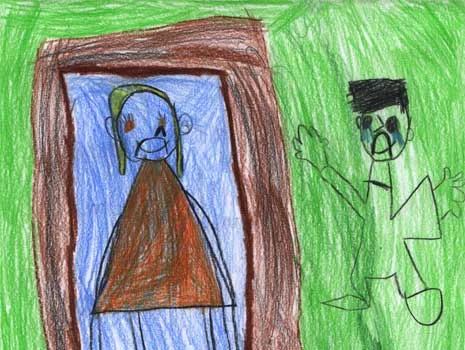
Here’s an example of the sort of religious – or mournful – images many of the kids produced. (The particular music that inspired this cheersome picture can be heard here)
Some general trends I found:
- The older the children, the more likely they were to produce “conceptual” images (e.g. a swirling mass of colour) as opposed to a representation of something tangible (e.g. somebody standing in a garden smiling). This may be because older children grasped more firmly that the purpose of the task was to translate a feeling, and from what they know about art, aged 9-11, the outcome ‘should be’ impressionistic.
- The vast majority of pictures included depictions of nature, ranging from a single giant ladybird to dramatic landscapes lashed by thunderstorms.
- Despite the fact that most of the musical excerpts were melancholic in mood, the majority of children drew pictures that exuded an overall feeling of happiness. (Though predictably this was more common in the younger pupils.)
- There was a higher proportion of “unrelated” drawings for styles of music that were (presumably) less recognisable to the children. For instance, there appeared to be greater aptitude for emotional translation with music by Rachmaninov (19/20th century, whose music influenced early film scores) than for a work by Barrière, a French Baroque composer.
It would be cool to do this again with more controlled conditions in the hope of drawing up a more reliable set of results, as of course you have to take into account factors like kids sitting around the same table (there were definite sets of themes in some cases), their teacher’s introduction to the task, and so on.
For the front cover of the programme we chose a well-considered depiction of a cat orchestra.